I often watch people take trades they have no reason to take, driven by an impulsive urge to simply be in the market. The adrenaline of participation can override common sense, especially when strong emotion is involved. Before you enter anything, ask yourself whether the trade fits your system, offers favorable reward against risk, and comes from genuine confidence in the setup rather than the need to trade.
The adrenaline rush of participation can overwhelm common sense and cause bad decisions, especially if there is any strong emotion involved.
Why are you taking that trade?
Before you take a trade in anything, ask yourself the following:
Does this trade fit in to my trading system?
Do I have favorable reward vs risk?
Am I taking this trade just to trade or am I very confident about the setup?
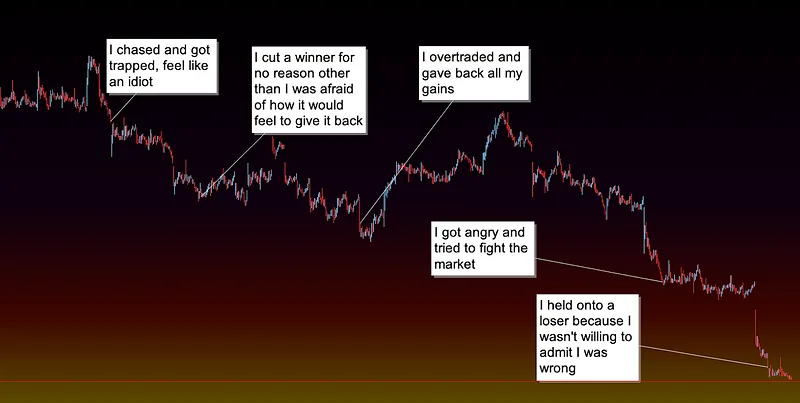
Be sure you understand what you are getting into before you get into it. I think a lot of traders lose money and eventually stop trading altogether because of poor impulse control.
And I get it, I really do. Trading brings about a lot of positive neurochemical reactions when we win. The rush of dopamine can feel very good because it gratifies us for our efforts. So we want to keep doing it again and again to re-experience that feeling.
But that isn't what trading is about. This isn't meant to feel like an addiction, it's meant to be a way to consistently generate returns.
Focus on finding discipline
Consistency comes from discipline, and discipline is the antithesis of addiction and impulsivity.
So what does that mean for us as traders?
It means we should be cognizant of our reasoning for entering and exiting positions. A trading journal and a system for which we qualify what is a trade we will take, how we will manage it, and why we are getting in or out is important.
It also means that we need to work on adapting and evolving to changing market conditions. What used to work isn't necessarily going to keep working. So be prepared to test new strategies as appropriate.

But most of all, be aware of how important discipline is to longer term success. Discipline means making sure that we are adherent to our trading system and style, it also means being cognizant of good risk management, and attempting to become consistent.
That consistency has a lot to do with two key themes. Cutting losers quickly to minimize risk and capital being tied up in bad trades, and riding winners as long as the trade thesis and momentum remain intact.
What matters
The difference between traders who last and those who quit is that survivors want to be around for the next trade. They take setups where the dynamics look favorable and step away when those dynamics change, cutting losers quickly while letting winners run as long as the thesis and momentum hold. Check your journal and your rules on the next trade: if it doesn't fit, don't take it.