
Checklist
The Daily-Chart Swing Checklist
Ten questions to answer after the close, before a multi-day position goes on. It is the same order the work happens in the room: context first, then the setup, then the size, then the plan for being wrong.
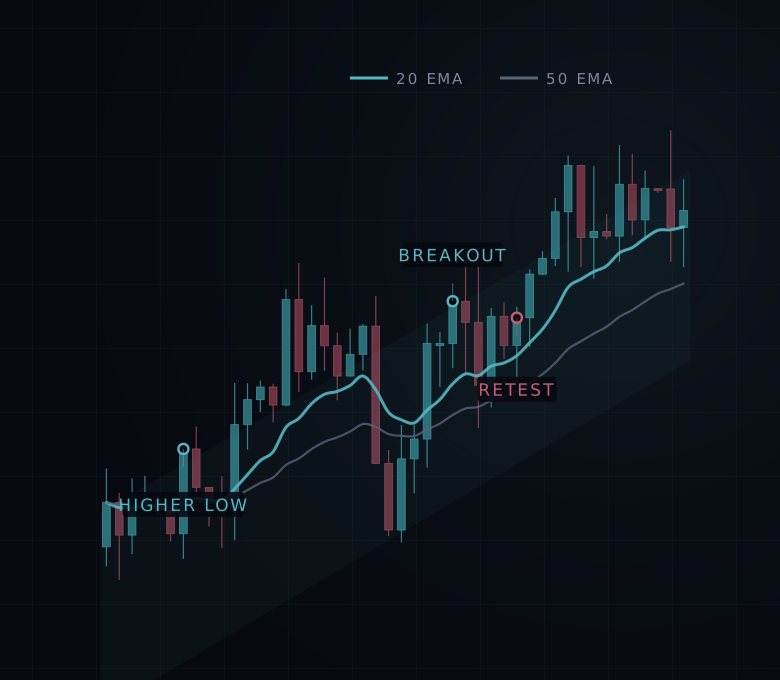
A checklist is not a strategy. It is the part of the process that stops the same four mistakes happening in the same four ways: taking a setup against the higher timeframe, sizing before the stop is known, entering without a reason to be wrong, and holding past the point where the premise failed. If a question cannot be answered, the trade is not ready.
1. Context
- 01
What is the weekly doing?
Trend, range or transition. A daily setup against a weekly trend needs more room and a faster exit than one with it.
- 02
Where is price in the range?
At the top, the bottom, mid-range, or breaking out. Where you are in the structure decides whether the reward is worth the risk.
- 03
Is there an event in the next five sessions?
Earnings, a central-bank decision, an expiry, a roll week. An event inside the holding period is part of the trade, not an interruption to it.
2. The setup
- 04
What is the signal, in one sentence?
If it takes three sentences and an indicator to justify, it is a hunch with decoration.
- 05
Where is the level the premise depends on?
The level that, if it breaks, means you were wrong. It should come from the chart, not from a round number or a percentage of the account.
- 06
Is the entry crowded?
Long into heavy call positioning or short into a wall of puts means the move you want may already be hedged. Positioning context is on the Gir page.
3. The risk
- 07
What is the size at this stop?
Run the numbers with the position size calculator before the order, not after. The stop distance sets the size, never the reverse.
- 08
What is the total heat with everything already open?
Three correlated positions at one percent each is not one percent of risk. The risk guide covers portfolio heat.
- 09
What happens on a gap?
A stop is an instruction, not a guarantee. If a gap through the stop would breach the daily loss limit, the size is too large.
4. The plan
- 10
What would make you exit before the stop?
Time stop, a failed retest, a change in positioning, a better use of the capital. Write it down now; it is much harder to invent at 14:00 tomorrow.
How to use it
Run the ten questions after the close, in order, in less than five minutes. Keep the answers in a journal entry for the trade. A month of them tells you something a screenshot cannot: which of the ten you skip when you are tired, and which setup produces most of your losses.
Related reading
- Swing trading: strategies, setups and risk — the overview this checklist assumes.
- The 1% rule and swing-trade risk — why the risk budget is a percentage of the account.
- Sizing by volatility — the ATR-based alternative to a fixed stop distance.
Is this a trading strategy?
No. It is a pre-trade checklist for a multi-day position. It does not generate entries and it does not predict anything.
Do I need the checklist before every trade?
Before every position you carry overnight. Day trades resolve in the session and have a different process.
How long should it take?
Under five minutes once the answers are habit. If it takes longer, the setup is usually not clear enough to take.
Can I use it for options and futures?
Yes. Questions 4 to 10 apply as written; options add expiry and implied volatility to the context, and futures add margin and roll week.
Run the checklist with the room
The paid Discord is where these questions get asked out loud, on real positions, before the trade goes on.