Two routes can leave you holding 100 shares at a known cost. One buys them at the market price today. The other sells a put that obliges you to buy them at the strike if the stock closes below it, and pays you for accepting that obligation. The strike and the expiry are fixed when you sell, so the comparison is arithmetic rather than opinion.
What separates the routes is the price you end up paying and what the cash does while you wait.
Two ways to end up owning the shares
Buying 100 shares settles the obligation at the fill. Cash leaves the account, the stock arrives, and the position carries full downside from that moment. Settlement two sessions later is bookkeeping; the risk starts immediately.
Selling one put moves the purchase to the other side of the contract. Someone pays you for the right to sell you 100 shares at the strike, and you agree to take the other side whenever they choose to use it. Your purchase still happens, but only if the stock is at or below the strike when the holder exercises. Above it the contract expires and no shares change hands.
The two entries are not priced alike. A 45 strike sold for 1.10 makes the stock cost 43.90 if the put is assigned, 12.2% under a stock trading at 50.00. Buying the shares today gives you no such improvement; your basis only falls if you buy more at a lower price later. The contract is the same decision as a limit order, with a credit attached, and the options guide covers where the credit comes from.
Cash timing separates them further. The stock purchase takes 5,000 and leaves you an asset you can sell at the market price whenever you want. The put reserves 4,500 against the strike and hands you 110, but that 4,500 is committed until the contract is closed, expires, or is assigned.
What the put pays you for
A short put is a liability you have agreed to carry. The buyer holds the choice of exercise and you hold the obligation, so part of the premium is payment for that imbalance. Single-stock options are American style, which means the buyer can exercise on any trading day rather than only at expiry.
The second thing the premium pays for is the cash. A 45 put ties up 4,500 for as long as the position is open and no other trade can use that balance. The credit for the whole contract is 110, which is 2.4% of the capital doing the work. That is the entire return for agreeing to own the stock 10% below the current price.
Cash-secured means the cash is in the account rather than borrowed against margin. If the 4,500 is not there, the broker treats the position as a margin put and the requirement changes along with the risk. The number that matters is strike times 100: three 45 puts need 13,500 available, whatever the premium happens to be.
The arithmetic side by side
The example is illustrative and round. A stock trades at 50.00, the account has 5,000 free, and the choice is between 100 shares and one 45 put sold for 1.10 with a month to expiry. No commissions, no early assignment, no dividends.
| Price at expiry | 100 shares at 50.00 | Profit | One 45 put at 1.10 | Profit |
|---|---|---|---|---|
| 55.00 | Worth 5,500 | +500 (+10.0%) | Expires worthless, keep 110 | +110 (+2.4%) |
| 45.00 | Worth 4,500 | −500 (−10.0%) | Expires worthless, keep 110 | +110 (+2.4%) |
| 38.00 | Worth 3,800 | −1,200 (−24.0%) | Assigned at 45.00, basis 43.90 | −590 (−13.1%) |
Read the 38.00 row twice. The stock path holds shares worth 3,800 against 5,000 spent, a loss of 1,200. The put path is assigned at 45.00, pays 4,500, and has already received 110, so the shares are carried at 43.90 and are worth 3,800. The loss is 590 on 4,500 committed, 610 smaller in dollars because the basis is 6.10 a share lower.
The break-evens are the real comparison. The stock needs 50.00 to get back to even and 51.10 to match the 110 the put already holds. The put breaks even at 43.90. Below 51.10 the put path finishes ahead in dollars, and under 45.00 the gap is a flat 610 per contract because both paths then own the same shares at different cost.
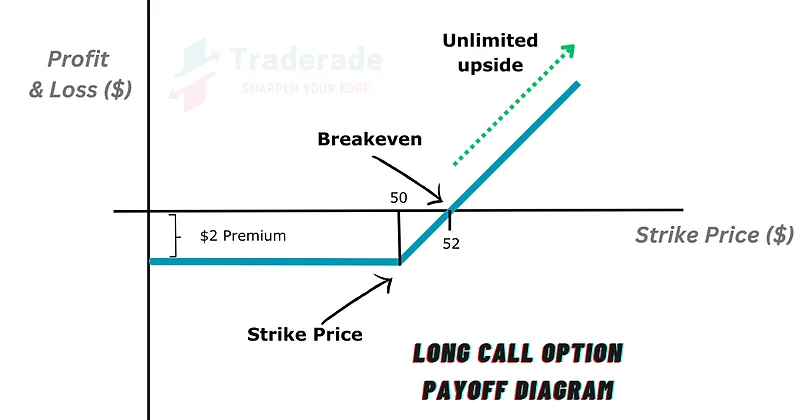
The put buys that advantage with a ceiling. However high the stock goes, the credit stays 110, so the stock path wins every dollar above 51.10 and keeps winning.
When the put wins
A flat, sideways or mildly higher month is the put’s home. In the example, any expiry between the strike and 51.10 leaves the put ahead of the stock purchase, and a month that ends at 47.00 pays 110 while the shares show a 300 loss.
Elevated implied volatility is the second condition. The credit is priced off implied volatility, so a 45 put sold for 1.60 instead of 1.10 brings the assigned basis to 43.40 and the break-even down with it. The strike has not moved; you are paid more for the same obligation.
A defined entry suits a trader who has decided the price at which the stock becomes interesting. Selling that strike turns a resting limit order that costs nothing into one that pays 110 while it waits. The wheel strategy is built on exactly this step, and it only repeats cleanly when the strike was one you wanted.
Not needing the shares today is the practical case for most accounts. If the thesis is a move higher over the next quarter, the put expresses it with 4,500 committed instead of 5,000 and at a basis 6.10 a share lower. What it gives up is participation above 51.10.
When the stock wins
A rally is where the ceiling costs real money. At 60.00 the shares are worth 6,000, a 1,000 gain, and the put has kept 110. The 890 difference does not come back, because the contract reached its maximum profit in the first week and stayed there.
Dividends belong to the shareholder. A short put receives nothing on the ex-dividend date, and the credit was fixed when you sold the contract so it does not grow because the company paid a distribution. Over a year of holding, that difference is real money in a dividend-paying name.
The committed cash is also harder to get back. Shares sell at the market price on any session; 4,500 behind a short put is released only by buying the contract back, and that buyback gets more expensive exactly when the stock falls.
Tax handling around the shares is simpler in one respect. In the US, option premium and assignment are short-term results for most accounts, and shares received by assignment start their holding period on the assignment date. A position meant to be held past a year begins that clock later than a purchase made today.
Cash, margin and assignment mechanics
Single-stock options are American style, so the holder can exercise on any trading day and does so most often when the put is in the money with little time value left. An assignment can arrive with three weeks still on the contract.
Exercise notices are processed after the close and assignments are delivered before the next session. A Friday close below the strike can mean 100 shares and a debit in the account on Monday morning, before you have a chance to trade the position.
The broker holds the requirement for as long as the short put is open. It is calculated from the strike rather than the current price, so a falling stock does not release cash; the balance stays pinned at 4,500 per contract even after the stock drops to 40.00.
If the cash is not there at assignment, the broker covers the shortfall by liquidating something, either other positions or the assigned shares themselves at whatever the market offers. That forced sale tends to land on the worst morning of the trade, and the account keeps the loss plus the commission. The risk management guide starts from the same premise: the position has to be affordable before it is opened.
Closing early has its own price. Buying the put back at 4.00 costs 290 per contract more than the 110 you took in, and that is the fee for getting the cash released before expiry.
Sizing a put you would be happy to own
The strike is the entry decision, so it has to be a price at which you want the shares. A 45 put on a stock at 50.00 is a 10% discount; a 49 put is a 2% discount that pays more premium and leaves almost no margin when the trade goes wrong. Selling the higher strike for the credit is how accounts end up long a stock they never wanted.
Size follows from the loss after assignment, not from the credit collected. An account of 50,000 with a 2% risk budget can lose 1,000 on the trade. Assigned at 43.90 and marked 20% lower at 35.12, one contract loses 878. A second contract takes the loss to 1,756, past the budget before anything else is considered.
Carrying the position to expiry without being forced out is the constraint the sizing has to respect. The 4,500 has to be spare cash rather than the balance that pays the month’s bills, and the rest of the book has to survive the stock sitting under the strike for a few weeks.
Staggering strikes and expiries is the alternative to one large position. Two 45 puts at different dates leave room to add on a further drop, and the second contract is only sold if the first assignment still fits the account. Run the figures through the position size calculator when the strike sits far from the current price, and decide before the order goes in what makes you buy the contract back.
Questions
If I sell a put and get assigned, is that the same as having bought the stock?
The result is the same 100 shares, but the path differs. Assignment happens only if the stock finishes below the strike, so you may never own it at all. When you do, the basis is the strike minus the premium you collected, and the cash left the account at assignment rather than on the day you sold the contract.
What am I being paid for when I sell a cash-secured put?
Two things. The buyer holds the right to decide whether the trade happens and you hold the obligation, so part of the credit pays for that. The rest pays for the cash the trade ties up: strike times 100 sits in the account until the contract is closed, expires or is assigned.
In the 50.00 example, where does the stock path overtake the put?
At 51.10. The put holds 110 whatever happens above the strike, and 100 shares bought at 50.00 gain the same 110 once the price reaches 51.10. Every dollar above that belongs to the shares alone, and by 60.00 the stock path is 890 ahead.
When does selling the put beat buying the shares?
Any expiry below 51.10 in the example leaves the put ahead, and the margin becomes a flat 610 once the stock is under 45.00. The conditions that make it likely are a flat or mildly higher month, elevated implied volatility in the credit, and a strike you wanted to own anyway.
What do I give up by selling the put instead of owning the stock?
Participation above the strike beyond the premium, any dividend paid before expiry, and access to cash that would otherwise be free. The upside is capped at 110 in the example no matter how far the stock runs, and the 4,500 comes back only by closing the contract or taking the shares.
Can assignment happen before expiry?
Yes. Single-stock options are American style, so the holder can exercise on any trading day, most often when the put is deep in the money with little time value left. Notices are processed after the close, so an assignment can arrive over a weekend with the contract still weeks from expiry.
How many contracts should I sell?
As many as the account can carry to expiry after assignment, worked out from the loss rather than the credit. Take the assigned basis, apply a plausible drop, and keep the resulting loss inside the risk budget. At 43.90 with a 20% fall, one contract costs 878 and two cost 1,756.
What is the usual mistake with cash-secured puts?
Selling a strike chosen for its premium rather than for the price at which the shares are worth owning, and selling more contracts than the cash can cover. The first turns a planned entry into a position bought too high; the second turns an assignment into a forced liquidation at whatever the market offers that morning.