
Reference
Trading and Investing Glossary
The working vocabulary behind the charts, orders and risk decisions on this site. Plain definitions, no jargon loops, and links back to the guides that use them.
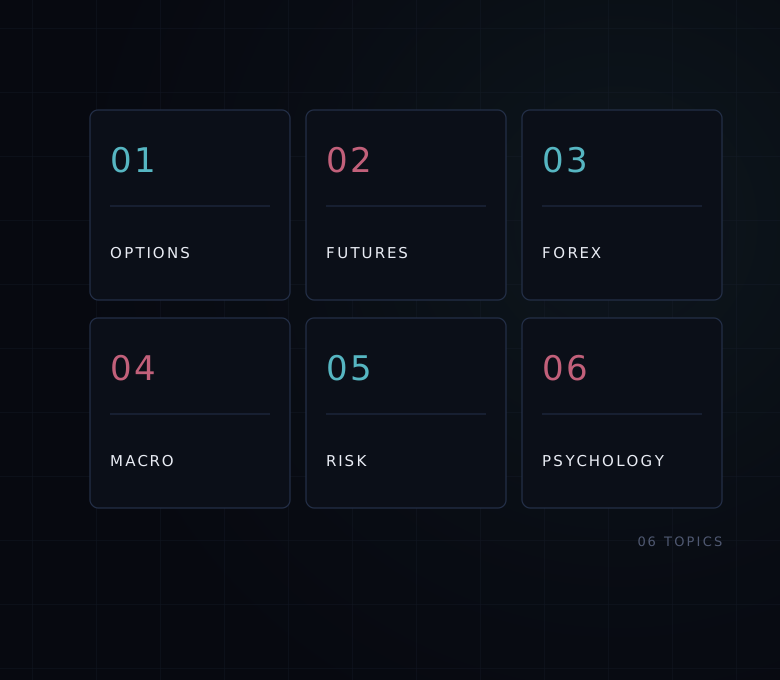
205 terms across market structure, orders, equities, options, futures, forex, fixed income, macro, technical analysis, risk, psychology and valuation. Terms are alphabetical; use the letter bar to jump.
A
- AlphaInvesting
- The return left after subtracting the return explained by the market or another benchmark. A positive alpha means the strategy beat its benchmark after the risk taken is accounted for.
- Annualized returnInvesting
- The compound yearly rate that turns a starting value into an ending value over a period longer or shorter than a year. It makes returns of different lengths comparable.
- ArbitrageMarket
- Buying an asset in one venue and selling it in another to capture a price difference. True riskless arbitrage is rare; most versions carry execution or timing risk.
- AskMarket
- The lowest price a seller is currently willing to accept. The ask is the price a buyer pays when submitting a marketable buy order.
- Ask sizeMarket
- The number of shares or contracts offered at the best ask. It is a snapshot of displayed supply, not the total size available in the market.
- AssetInvesting
- Something that can be owned and has the potential to produce value: cash, a stock, a bond, a futures contract, property or a claim on cash flows.
- Asset allocationInvesting
- The split of a portfolio across asset classes such as stocks, bonds, cash and alternatives. It is the main driver of a portfolio's long-run risk and return.
- At-the-moneyOptions
- An option whose strike is at or close to the current price of the underlying. At-the-money options carry mostly time value and are highly sensitive to volatility.
- AuctionMarket structure
- A process that matches buyers and sellers at a single clearing price. Opening and closing auctions concentrate liquidity and can produce prints materially different from the preceding continuous session.
- Average true rangeTechnical
- The average of the true range over a chosen lookback, where true range accounts for the prior close as well as the high and low. Traders use it to size stops and compare volatility across instruments.
B
- BackwardationFutures
- A futures curve where near-dated contracts trade above later-dated contracts. It often reflects tight nearby supply or a convenience yield for holding the physical commodity.
- BasisFutures
- The difference between the futures price and the spot price of the underlying. Basis converges toward zero as the contract approaches expiry.
- Bear marketMarket
- A sustained decline commonly defined as a 20% or greater fall from a recent high. The label describes direction and depth, not the cause or the duration.
- BetaRisk
- A measure of how much an asset has moved relative to a market benchmark. A beta above one means the asset has historically amplified benchmark moves; below one means it has dampened them.
- BidMarket
- The highest price a buyer is currently willing to pay. The bid is the price a seller receives when submitting a marketable sell order.
- Bid-ask spreadMarket
- The difference between the best bid and the best ask. It is a trading cost: a wider spread means a larger immediate loss when buying and then selling at the same moment.
- Black swanRisk
- A rare, high-impact event that was not in the normal risk model. The label is about surprise and scale, not a claim that the event was impossible to imagine.
- BondFixed income
- A loan to an issuer that pays interest and returns principal on a schedule. Bond prices move inversely to yields and carry credit, interest-rate and liquidity risk.
- BreakoutTechnical
- A move through a defined support, resistance or range boundary. A breakout is only confirmed by follow-through; a move that reverses back into the range is a fakeout.
- Bull marketMarket
- A sustained rise in prices, commonly described as a 20% or greater advance from a low. It is a direction-and-duration label, not a guarantee that every asset is rising.
- BuybackEquities
- A company purchasing its own shares, usually to reduce the share count or return cash to holders. It can support earnings per share without improving the underlying business.
- Buying powerRisk
- The capital available to open positions after cash and margin requirements are considered. It is not the same as account equity, and it can change when volatility or holdings change.
C
- Call optionOptions
- A contract that gives the buyer the right, but not the obligation, to buy the underlying at the strike before expiration. The seller receives premium and carries the obligation if assigned.
- CapitalInvesting
- Money committed to an investment or trading account. Capital is finite; position sizing and risk limits exist to keep a bad sequence from removing the ability to continue.
- Capital gainsTax
- The profit from selling an asset above its cost basis. Tax treatment depends on holding period, jurisdiction and the type of asset, so the tax result can differ from the trading result.
- Cash-settledDerivatives
- A contract that settles in cash rather than by delivering the underlying. Index options and many futures are cash-settled, which removes physical delivery but not mark-to-market risk.
- Central bankMacro
- An institution that sets monetary policy, supervises banks and manages the currency. Its rate decisions and balance-sheet actions drive discount rates, liquidity and currency expectations.
- Circuit breakerMarket
- A rule that pauses trading after a large move. The pause gives the market time to process information; it does not guarantee that prices will stabilise when trading resumes.
- ClearingMarket
- The process of confirming, netting and guaranteeing trades between execution and settlement. A clearing house stands between counterparties and manages the risk that one side fails.
- CommissionCost
- A fee paid to a broker or venue for executing a trade. Commission is separate from spread and slippage, and all three belong in the expected cost of a strategy.
- CompoundingInvesting
- Returns earned on previous returns as well as on the original capital. Compounding is powerful over long periods and equally powerful when losses compound against an account.
- ContangoFutures
- A futures curve where later-dated contracts trade above near-dated contracts. It often reflects storage, financing and insurance costs, and it can make rolling a long position expensive.
- CorrelationRisk
- A measure from -1 to +1 of how two series move together. Correlation is not causation and can change sharply in a crisis, which is why diversified positions can become one risk when it matters.
- Cost basisTax
- The original cost of an asset, adjusted for commissions, splits and certain distributions. Gain or loss is measured from cost basis, not from the last price remembered.
- Covered callOptions
- Selling a call against shares you own. The premium reduces the cost of the position, but upside above the strike is capped and the shares can be called away.
- Credit spreadOptions
- An options position that is opened for a net credit, usually by selling one option and buying another further out as protection. The maximum profit is the credit; the maximum loss is the width of the spread minus that credit.
- Current ratioEquities
- Current assets divided by current liabilities. It is a rough liquidity check: a ratio below one means short-term obligations exceed short-term assets on the balance sheet.
D
- Dark poolMarket structure
- A private trading venue where orders are matched without displaying the full book. Dark pools can reduce market impact for large orders, but they also reduce pre-trade transparency.
- Day orderOrders
- An order that expires at the end of the trading session if it has not filled. It does not carry into the next session unless the trader submits it again.
- DealerMarket
- A firm that quotes prices and trades as principal rather than only matching a client with another client. Dealers hold inventory and earn the spread while managing the risk of that inventory.
- Debit spreadOptions
- An options position opened for a net debit, usually by buying one option and selling another. The debit is the maximum loss; the difference between strikes limits the maximum gain.
- DefaultCredit
- Failure to meet a contractual payment obligation. In bonds and credit markets, default risk is priced into spreads and is distinct from interest-rate risk.
- DeltaOptions
- The change in an option's price for a one-point move in the underlying, all else equal. Delta also approximates the equivalent share exposure and is a key input to hedging.
- DerivativeMarket
- A contract whose value depends on an underlying asset, rate, index or event. Options, futures, forwards and swaps are derivatives; leverage is built into their economics.
- Disposition effectPsychology
- The tendency to sell winners too early and hold losers too long. It feels like protecting gains and avoiding regret, but it can distort the risk of the portfolio.
- DiversificationRisk
- Spreading exposure across assets or strategies that do not move together. It reduces company-specific risk, but it cannot remove market risk or the risk that correlations converge.
- DividendEquities
- A cash or stock distribution paid to shareholders from company resources. A dividend is not free money: the share price typically adjusts by the distribution on the ex-dividend date.
- Dollar-cost averagingInvesting
- Investing a fixed amount at regular intervals regardless of price. It removes timing decisions from the contribution, but it does not guarantee a better return than a lump sum.
- DrawdownRisk
- The decline from an account or strategy peak to a later trough, usually measured as a percentage. Drawdown is the lived experience of risk, even when the long-run return is positive.
- DurationFixed income
- A measure of a bond's price sensitivity to changes in interest rates, expressed in years. Longer duration means a larger price move for a given change in yield.
E
- EBITDAEquities
- Earnings before interest, taxes, depreciation and amortisation. It is a rough operating cash-flow proxy, not cash flow, and it ignores capital expenditure and working-capital needs.
- Effective spreadMarket structure
- The realised cost of a trade relative to the midpoint at the time of execution, including price improvement or adverse fills. It is often more useful than the quoted spread.
- Enterprise valueEquities
- Market value of equity plus debt and other claims, minus cash. It is the price of the whole business, which is why it is used with EBITDA or revenue for comparisons.
- EquityInvesting
- Ownership value in a company, or the account value after liabilities. In a brokerage account, equity is what remains after borrowed money is subtracted.
- ETFInvesting
- A fund that trades intraday like a stock and usually tracks an index, sector or basket. ETFs can be cheap and liquid, but they still carry the risk of the underlying holdings.
- European optionOptions
- An option that can be exercised only at expiration. Most index options are European-style, which removes early-exercise decisions but not the risk of assignment at expiry.
- ExchangeMarket
- A regulated venue that lists and matches orders. Exchanges publish rules, provide price discovery and sit inside a broader market that includes off-exchange venues.
- ExerciseOptions
- Using the right to buy or sell the underlying at the strike. Exercise converts an option position into stock or cash settlement and can create obligations for the seller.
- ExpectancyRisk
- The average result per trade after win rate, average win and average loss are combined. A positive expectancy is necessary; a high win rate alone is not enough.
- ExpirationOptions
- The date and time after which an option can no longer be exercised. Expiration also brings assignment, pin risk and a sharp change in the option's remaining time value.
- ExposureRisk
- The amount of value at risk from a position, factor or market move. Exposure can be direct, through shares, or indirect, through options, correlations and currency.
F
- Fair valueValuation
- An estimate of what an asset is worth based on cash flows, comparable assets or a model. Fair value is an estimate, not a price the market is obliged to accept.
- Fibonacci retracementTechnical
- A set of ratios used to mark possible pullback levels within a trend. The levels are a framework for watching reactions, not a prediction that price must stop there.
- FillExecution
- The completion of an order, in whole or in part. The fill price and size are the reality; the quote at the moment of submission is not.
- Fixed incomeFixed income
- The asset class of loans and bonds that pay interest or a defined cash flow. Fixed-income returns are driven mainly by interest rates, credit spreads and default expectations.
- FloatEquities
- The shares available to trade after insiders, restricted holders and other locked-up owners are excluded. A small float can amplify moves in both directions.
- ForexForex
- The market for exchanging currencies, quoted in pairs. Most volume is over the counter, and leverage, session timing and interest-rate differentials are central to the risk.
- Forward contractDerivatives
- A private agreement to buy or sell an asset at a future date and agreed price. Forwards are customised and carry counterparty risk, unlike standardised futures.
- Free cash flowEquities
- Cash from operations minus capital expenditure. It is the cash available for debt reduction, dividends, buybacks or reinvestment, and it is harder to manipulate than accounting earnings alone.
- Front monthFutures
- The nearest expiring futures contract for a product. It usually carries the most volume, but liquidity can migrate to the next contract as expiry approaches.
- FuturesFutures
- Exchange-traded contracts for a future delivery or cash settlement. They are used to hedge, speculate and express a view with capital efficiency, but daily margin calls can force decisions.
- Futures contractFutures
- A standardised agreement to buy or sell an asset at a set price on a future date. Futures are margined and marked to market daily, so leverage and liquidity risk are built in.
G
- GammaOptions
- The rate at which delta changes as the underlying moves. Gamma is highest near the money and near expiration, which is why short-dated option risk can change quickly.
- GapTechnical
- A price jump between one session's close and the next session's open, leaving an unfilled range on the chart. Gaps can be caused by news, earnings or overnight flows and may or may not fill.
- GEXOptions
- Dealer gamma exposure, an estimate of the aggregate gamma held by option dealers. It is a model of positioning, not a direct observation of every dealer's book.
- Golden crossTechnical
- A shorter moving average crossing above a longer one. It is a lagging trend signal; the crossing describes what has already happened, not what must happen next.
- GoodwillAccounting
- The premium paid in an acquisition above the fair value of identifiable net assets. Goodwill can be impaired, and impairment is an accounting charge that does not involve current cash.
- Gross marginEquities
- Revenue minus cost of goods sold, divided by revenue. It shows pricing power and production economics before operating expenses, and it is most useful when compared with peers.
H
- HaircutMarket structure
- A discount applied to the value of collateral for lending or margin purposes. A larger haircut means the borrower must post more collateral for the same exposure.
- HedgeRisk
- A position or contract intended to offset a risk elsewhere in the portfolio. A hedge reduces one exposure but introduces cost, basis risk and the possibility of imperfect protection.
- High-yield bondFixed income
- A bond rated below investment grade, offering a higher yield to compensate for higher default risk. The extra yield is compensation, not a free lunch.
- Holding periodInvesting
- The length of time an asset is held. It affects taxes, compounding, transaction costs and the amount of time a thesis has to play out.
- Horizontal spreadOptions
- An options spread with the same strike but different expirations, also called a calendar or time spread. It trades the difference in time decay and volatility between two expiries.
I
- Implied volatilityOptions
- The volatility input that makes an option model match the market price. It is the market's forward-looking uncertainty estimate, not a forecast of direction.
- In-the-moneyOptions
- An option with intrinsic value: a call whose strike is below the underlying, or a put whose strike is above it. In-the-money options carry more delta and less time value than out-of-the-money options.
- IndexMarket
- A calculated measure of a group of assets, usually weighted by market value, price or another rule. An index is a benchmark; it is not directly tradable unless a fund or derivative tracks it.
- Index fundInvesting
- A fund designed to track an index rather than select securities. Low costs and broad exposure are the appeal; the fund still falls when the index falls.
- InflationMacro
- A sustained rise in the general price level, which reduces the purchasing power of cash. Central banks respond to it with policy, and markets reprice rates and earnings expectations.
- Initial marginFutures
- The collateral required to open a futures position. It is a performance bond, not a down payment, and it can be raised by the exchange or broker when volatility rises.
- Insider tradingRegulation
- Trading on material non-public information in breach of a duty. Legal insider buying and selling by executives is disclosed; illegal insider trading is not the same thing.
- Interest rateMacro
- The cost of borrowing or the return on lending money, usually expressed as an annual percentage. Rates affect discount rates, bond prices, currencies and the relative appeal of risk assets.
- Intrinsic valueOptions
- The amount an option would be worth if exercised immediately: the underlying price minus the strike for a call, or the strike minus the underlying for a put. It cannot be negative.
- IPOEquities
- An initial public offering in which a private company sells shares to public investors. IPO pricing is set before trading, and the first-day range can be far from the underwriter's estimate.
- Iron condorOptions
- A four-leg options position that sells a call spread and a put spread around the current price. It profits from time decay and range-bound movement, with defined risk on both sides.
J
- January effectMarket
- The historical tendency for small-cap stocks to outperform in January. The pattern is not reliable in every year and is weaker than the folklore suggests.
- Jobless claimsMacro
- A weekly count of new unemployment-benefit applications. It is a high-frequency labour-market indicator; one print is noisy, while the trend and the four-week average carry more information.
K
- Kelly criterionRisk
- A formula for sizing a bet to maximise long-run growth given an edge and the payoff odds. Full Kelly is aggressive and volatile; many traders use a fraction of it.
- Key rate durationFixed income
- A measure of how much a bond's price changes when one point on the yield curve moves while the rest stays fixed. It exposes curve risk that a single duration number hides.
L
- LEAPSOptions
- Long-dated equity options, usually with more than a year to expiration. They give long exposure with less capital but still carry time decay and volatility risk.
- LeverageRisk
- Using borrowed money, margin or a derivative to control more exposure than the capital committed. Leverage magnifies both gains and losses and can force liquidation at the worst time.
- Limit orderOrders
- An order to buy at or below a specified price, or sell at or above it. A limit order controls price but not execution; the market can move away and leave it unfilled.
- LiquidityMarket
- The ease of trading a size without moving the price. Liquidity is not constant: it can disappear in stress, which is when the ability to exit matters most.
- Liquidity riskRisk
- The risk of being unable to exit a position at a fair price, or of moving the market while trying. It is highest in small caps, wide options and stressed markets.
- LongMarket
- Owning an asset or holding a position that benefits when its price rises. Long exposure can be direct, through shares, or synthetic, through options or futures.
- Loss aversionPsychology
- The tendency to feel a loss more strongly than an equivalent gain. It can produce premature profit-taking, loss-holding and position sizes that do not match the written plan.
- LotMarket
- A standard unit of trading size. Equities trade in shares, futures in contracts and forex in lots; the lot size determines the notional exposure and the value of a tick.
M
- MACDTechnical
- Moving Average Convergence Divergence, a trend-following indicator built from two moving averages and a signal line. It is lagging, best used with trend and price context rather than as a standalone trigger.
- Maintenance marginFutures
- The minimum collateral required to keep a futures position open. If equity falls below it, the broker can issue a margin call or liquidate the position.
- MarginRisk
- Collateral posted to support a leveraged position, or the amount borrowed from a broker. Margin is a constraint on survival, not a measure of conviction.
- Margin callRisk
- A demand to add collateral or reduce a position when account equity falls below the required level. The broker can liquidate without waiting for the trader to decide.
- MarketMarket
- The collection of buyers, sellers, venues and intermediaries that set prices for an asset. A market can be centralised on an exchange or fragmented across exchanges and private venues.
- Market capEquities
- Share price multiplied by shares outstanding. It is a simple size measure, but it ignores debt, cash and the difference between public and restricted shares.
- Market makerMarket
- A firm that continuously quotes bid and ask prices and tries to earn the spread while managing inventory. Market makers provide liquidity but are not obliged to protect a trader from adverse moves.
- Market orderOrders
- An order to buy or sell immediately at the best available price. It prioritises execution over price, so slippage is possible in fast or thin markets.
- Market profileTechnical
- A way of organising price and time to show where the market accepted or rejected value. It is related to volume profile but uses time-price opportunities rather than volume at price.
- Market riskRisk
- The risk that broad market moves affect a position regardless of company-specific news. It cannot be diversified away within one market and is often the largest single exposure.
- Max drawdownRisk
- The largest peak-to-trough decline in an equity curve over a period. It describes the worst historical pain, not the worst possible future pain.
- MoneynessOptions
- Whether an option is in, at or out of the money relative to the underlying. Moneyness is a snapshot; it changes as the underlying moves.
- Moving averageTechnical
- The average price over a rolling window, plotted as a line. It smooths noise and defines trend direction, but it lags price and can whipsaw in a range.
N
- Naked optionOptions
- A short option position without shares, cash or another option covering the obligation. The risk can be large and, for calls, theoretically unlimited.
- Net marginEquities
- Net income divided by revenue. It shows how much of each sales dollar reaches the bottom line after all expenses, interest and taxes.
- NFPMacro
- Non-farm payrolls, the US monthly employment report excluding farm workers. It is a major macro release; the market reacts to the surprise versus expectations, not only the headline number.
- Notional valueDerivatives
- The face value of a derivative's underlying exposure, before margin. A small margin payment can control a much larger notional position, which is the source of leverage.
O
- Open interestDerivatives
- The number of contracts outstanding at a given time. It measures participation and position-building, not volume; volume counts trades, while open interest counts contracts still open.
- OptionOptions
- A contract giving the buyer a right, and the seller an obligation, tied to an underlying at a set strike and expiration. The buyer pays premium; the seller carries assignment risk.
- Option chainOptions
- The list of available calls and puts for one underlying, organised by expiration and strike. It shows prices, volume, open interest and implied volatility across the surface.
- Order bookMarket structure
- The visible queue of bids and asks at each price level. The book is only the displayed liquidity; hidden and off-exchange liquidity can change the real depth.
- Out-of-the-moneyOptions
- An option with no intrinsic value: a call above the underlying, or a put below it. It is cheaper than an in-the-money option because it needs a larger move to pay off.
- OvertradingPsychology
- Taking more trades than the plan supports, often to recover a loss or to satisfy the urge to act. It raises costs and turns a tested process into improvisation.
P
- P/EEquities
- Price-to-earnings ratio: share price divided by earnings per share. It is a relative valuation shortcut, meaningful only against growth, risk and peers.
- Passive investingInvesting
- Holding a broad market exposure with minimal security selection, usually through index funds or ETFs. It is not risk-free; it accepts market risk in exchange for low cost and low turnover.
- Pattern day traderRegulation
- A US margin-account classification for traders who execute four or more day trades in five business days. It imposes a minimum equity requirement and is often confused with the strategy itself.
- PipForex
- The smallest standard price increment in a currency pair, usually the fourth decimal for major pairs. Pip value depends on lot size and the quote currency.
- PortfolioInvesting
- The collection of positions, cash and risks held together. Portfolio risk is not the sum of position risks; correlations determine how the pieces behave as a group.
- PositionTrading
- A holding in an asset, long or short, with a size and a risk. A position is a decision about exposure, not just a ticker.
- Position sizingRisk
- Choosing how much capital to commit to a trade from the stop distance and the acceptable loss. Correct sizing keeps one bad trade from becoming an account-level event.
- Price-to-bookEquities
- Share price divided by book value per share. It is most useful for banks and asset-heavy businesses; for asset-light companies, book value can be a weak anchor.
- Profit factorRisk
- Gross profit divided by gross loss over a set of trades. A profit factor above one means the strategy made money before costs; it says nothing about the path or the sample size.
- Put optionOptions
- A contract giving the buyer the right to sell the underlying at the strike before expiration. Puts can hedge downside or express a bearish view; sellers collect premium and carry assignment risk.
Q
- Quantitative easingMacro
- Central-bank purchases of assets intended to lower long-term rates and add liquidity. It can support risk assets, but its effects are uneven and its exit can be disruptive.
- Quick ratioEquities
- Cash, marketable securities and receivables divided by current liabilities. It is a stricter liquidity test than the current ratio because inventory is excluded.
- QuoteMarket
- The current bid and ask for an asset. A quote is a snapshot, not a promise; size and price can change before an order reaches the venue.
R
- R multipleRisk
- Profit or loss on a trade divided by the amount risked at entry. A 2R win means the trade made twice the initial risk, which makes outcomes comparable across position sizes.
- RebalancingInvesting
- Returning a portfolio to its target weights after market moves. It enforces selling what has run and buying what has fallen, and it can be done on a calendar or threshold basis.
- Relative strengthTechnical
- The performance of one asset compared with a benchmark or another asset. It is not RSI; relative strength is a ratio of returns, while RSI is a bounded momentum oscillator.
- ResistanceTechnical
- A price zone where selling has previously overcome buying. It is a location for observing reaction, not a wall that cannot be broken.
- ReturnInvesting
- The gain or loss on an investment over a period, including income and price change. Return is meaningless without the risk and time taken to produce it.
- Return on equityEquities
- Net income divided by shareholders' equity. It shows how efficiently equity is used, but it can be flattered by leverage and by a small equity base.
- ReversalTechnical
- A change in the direction of price after a trend. A single candle is not a reversal; confirmation comes from structure, follow-through and the loss of the prior swing.
- RiskRisk
- The possibility that an outcome differs from the plan, especially the possibility of a loss that impairs the account. Risk is not just volatility; it includes liquidity, leverage and behaviour.
- Risk of ruinRisk
- The probability that a strategy or account falls to a level from which it cannot continue. It rises with position size, drawdown and the absence of a hard risk limit.
- Risk-free rateMacro
- The return on a presumed default-free asset, usually a short-dated government bill. It is a benchmark for discounting cash flows and for judging whether a risky return is worth it.
- RollFutures
- Moving a position from an expiring contract to a later one. The roll can cost or pay depending on the curve, and it is a decision separate from the original trade thesis.
- RSITechnical
- The Relative Strength Index, a bounded momentum oscillator comparing average gains and losses over a lookback. It can stay overbought or oversold for a long time and is not a standalone signal.
S
- ScalpTrading
- A short-term trade that tries to capture a small move, often within minutes. Scalping depends on execution, spread and latency; it is a different business from swing trading.
- Sector rotationInvesting
- Moving capital between sectors as the economic or rate environment changes. It is a top-down bet, and it can fail when correlations rise or the regime shifts faster than the rotation.
- SettlementMarket
- The final transfer of cash or securities after a trade. Settlement timing affects funding, counterparty risk and when proceeds become usable.
- Sharpe ratioRisk
- Excess return divided by volatility over a period. It rewards smooth returns and penalises volatility, but it treats upside and downside moves the same and can be flattered by illiquid marks.
- ShortMarket
- Selling an asset you do not own, usually by borrowing it, to profit if the price falls. Short positions have borrowing costs, recall risk and, for calls, theoretically unlimited loss.
- Short interestEquities
- The number of shares sold short and not yet covered, usually expressed as a percentage of float. High short interest can fuel squeezes, but it also signals disagreement and borrow costs.
- Short squeezeEquities
- A rapid rise driven by short sellers buying back borrowed shares. It is a positioning event, not proof that the business is improving, and it can reverse violently.
- SlippageExecution
- The difference between the expected price and the actual fill. Slippage grows with order size, volatility and thin liquidity, and it is a real cost even when commissions are zero.
- SpeculationTrading
- Taking risk to profit from a price move rather than from holding an asset for income or ownership. Speculation is not inherently reckless; the distinction is process, sizing and honesty about the bet.
- SpreadMarket
- The gap between two prices, most commonly the bid and ask. In options, a spread can also mean a multi-leg position; the context decides which meaning applies.
- StockEquities
- An ownership interest in a corporation, represented by shares. A stock's return comes from price change and distributions, and its risk depends on the business, the price paid and the market.
- Stop-limit orderOrders
- An order that becomes a limit order once a stop price is reached. It controls the worst price but can remain unfilled if the market gaps through the limit.
- Stop-loss orderOrders
- An order designed to exit a position after a specified adverse move. It is a risk instruction, not a guarantee: gaps and thin liquidity can fill it far from the stop.
- StrikeOptions
- The price at which an option can be exercised. The strike, expiration and underlying together define the contract's payoff.
- SupportTechnical
- A price zone where buying has previously absorbed selling. It is a reference for risk and reaction, not a promise that price will hold.
- Swing highTechnical
- A local peak with lower highs on both sides. Swing structure gives a measurable place to define trend, stops and invalidation.
- Swing tradingTrading
- Holding a position for days to weeks to capture a multi-day move. It sits between day trading and long-term investing and requires overnight and event risk to be part of the plan.
T
- Take-profit orderOrders
- An order that closes a position at a specified favorable price. It automates an exit but does not adapt to a market that keeps running or reverses before the level.
- Technical analysisTechnical
- Reading price, volume and structure to frame probabilities and risk. It does not know the future; it provides levels and context for decisions.
- ThetaOptions
- The change in an option's price for one day passing, all else equal. Long options pay theta; short options collect it and carry the risk of a large move.
- TickMarket
- The minimum price increment for an instrument. Tick size determines the smallest spread and the value of a one-tick move.
- Time decayOptions
- The loss of option value as expiration approaches, all else equal. It accelerates near expiry and is the main cost of holding long options without a move.
- TradingTrading
- Buying and selling to profit from price changes over a defined horizon. Trading is a process of risk, execution and review, not a collection of predictions.
- Trailing stopOrders
- A stop that moves with the favorable price and stays fixed when price moves against the position. It locks in gains but can be shaken out by normal noise.
- Treasury billFixed income
- A short-dated US government security issued at a discount and repaid at face value. Bills are a reference for the short risk-free rate and cash-like collateral.
- TrendTechnical
- A sequence of higher highs and higher lows, or lower highs and lower lows. A trend is a description of structure, not a guarantee that the next move continues.
U
- UnderlyingDerivatives
- The asset, index, rate or price on which a derivative's value depends. The underlying is what the contract ultimately references, even when settlement is in cash.
- UnwindTrading
- Closing or reversing a position, often by executing the opposite trade. Large unwinds can move prices when many participants exit the same exposure at once.
- Uptick ruleMarket structure
- A US short-sale restriction that can require a short sale to execute above the best bid after a sharp decline. It is a market-structure rule, not a ban on short selling.
V
- Value at riskRisk
- An estimate of the loss a portfolio could exceed with a given probability over a given horizon. VaR is model-dependent and says nothing about the size of the loss beyond the threshold.
- VegaOptions
- The change in an option's price for a one-point change in implied volatility. Long options are usually long vega; short options are usually short vega.
- VIXMacro
- The CBOE Volatility Index, a measure of expected 30-day S&P 500 volatility derived from option prices. It is not a price forecast and it is not directly tradable without a derivative.
- VolatilityMarket
- The dispersion of returns or the market's expectation of it. Volatility is not direction; it is the size of the moves, and it affects option prices, stops and position sizing.
- Volatility smileOptions
- The pattern where implied volatility differs across strikes, often higher in the wings. It shows that one volatility number does not describe the whole option surface.
- VolumeMarket
- The number of shares or contracts traded in a period. Volume confirms participation but does not say whether buyers or sellers were more aggressive.
- VWAPTechnical
- Volume-weighted average price, the average price weighted by volume over a session or period. It is a benchmark for execution and a reference for intraday value, not a prediction.
W
- WarrantEquities
- A company-issued security that gives the holder the right to buy shares at a set price before expiration. Warrants dilute existing shareholders and trade separately from the stock.
- Wash saleTax
- A US tax rule that disallows a loss when a substantially identical security is repurchased within 30 days before or after the sale. It is a tax rule, not a trading rule.
- WedgeTechnical
- A converging price pattern with a slope, often read as compression or exhaustion. The pattern frames a decision; the breakout or breakdown provides the evidence.
- Win rateRisk
- The percentage of trades that are profitable. It is only meaningful alongside average win, average loss and sample size; a high win rate can still lose money.
- Working capitalEquities
- Current assets minus current liabilities, the capital tied up in day-to-day operations. Negative working capital is not automatically bad, but it can signal a funding dependency.
Y
- YieldFixed income
- The return an investment produces, usually expressed as an annual percentage. Yield depends on price, coupon and time horizon, and it is not the same as total return.
- Yield curveMacro
- The relationship between yields and maturities for similar bonds. Its shape reflects expectations for rates, growth and inflation, and an inversion is a signal, not a recession date.
- Yield spreadFixed income
- The difference in yield between two bonds or sectors, often used to price credit or liquidity risk. A wider spread means the market demands more compensation.
- Yield to maturityFixed income
- The total return on a bond held to maturity, assuming coupons are reinvested at the same rate. It is a yield calculation, not a guarantee of the realised return.
Z
- Zero-coupon bondFixed income
- A bond that pays no periodic interest and is issued at a discount to face value. Its return comes from the price converging to face value at maturity, which makes duration high.
- Zero-day optionOptions
- An option that expires on the same day it is traded, often called 0DTE. Its value is almost entirely time and gamma, and its risk can change within minutes.
Want the room, not just the vocabulary?
The Traderade Discord is where the daily-chart work happens: ideas with reasoning, live futures streams and the in-house tools.