A short put spread below the market and a short call spread above it, same expiry, same underlying: that is an iron condor. You collect the difference between the two credits and take on a capped loss on both sides.
It suits a trader who expects the underlying to hold a range and wants the position defined whatever happens. The definition costs a small credit against a loss several times larger, so the trade lives or dies on strike placement and on the price of volatility at entry.
The four legs
Start with the put side. Sell the put whose strike sits nearest the market and buy the put one wing width lower. The short put brings in more premium than the long put costs, and the spread opens for a credit. The long put caps the loss: below its strike both puts are in the money, and the spread stops losing at the wing width.
Scroll sideways to read the full diagram.
The call side mirrors it. Sell the call nearer price, buy the call one wing width higher, keep the difference. Four legs, two spreads, one net credit in the account when the fill clears.
The wings can differ in width. A 5-point put wing with a 10-point call wing is a normal shape when the put side has to sit further from price than the call side. Wider wings collect more credit and lose more when tested, which makes the width a margin decision before it is a probability decision.
The long legs remove the uncapped loss of a naked short. They do not make the position safe. You are short two vertical spreads, and a move to either side costs money at a fixed rate until the far strike is reached. The spreads walkthrough prices the two-leg version leg by leg, which is the same arithmetic applied twice here.
Where the credit comes from
An iron condor is short volatility twice: short vega while there is time left, short theta as expiry approaches. Both sit inside the credit. When implied volatility on the underlying is high against its own recent range, the same strikes carry more premium, and a 5-wide condor collects 1.10 instead of 0.60.
That price difference is most of the edge. Sell the structure after a volatility collapse and you take the identical risk for less. The credit falls, the max loss rises by the same amount, and both break-even points move closer to the current price. You then need a narrower range to make the same money.
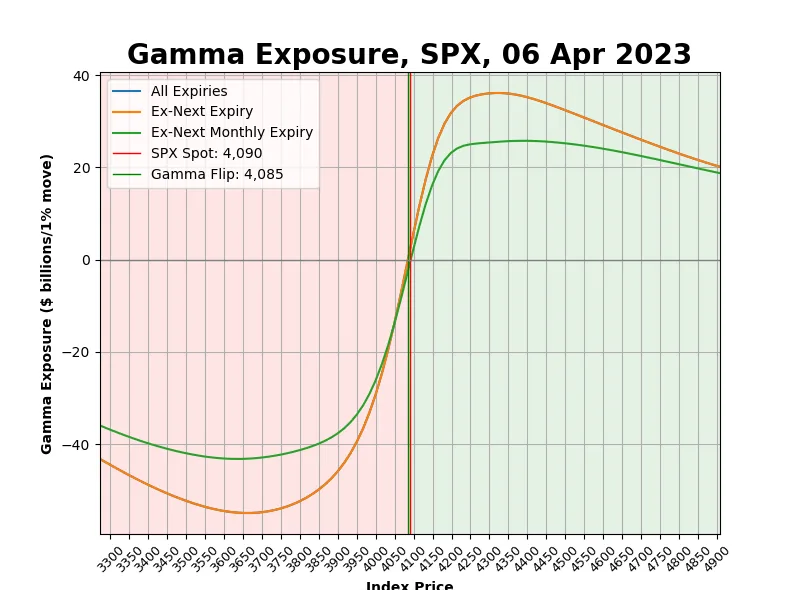
Index condors carry an extra variable. Dealer positioning in SPX and SPY changes whether hedging dampens or amplifies a move: positive gamma pulls price back toward the strikes with the most open interest, negative gamma pushes a move further. Options Viz maps where that exposure sits, which is a better guide to the likely range than a pattern on the chart.
One check before sending the order: price the same strikes at the implied volatility of two weeks ago. A large gap means you are selling volatility that has already fallen, so the range you need is tighter than the market priced a fortnight earlier.
Strike placement
Place the short strikes by delta rather than by point distance. Fifteen delta on both sides is a common band. Twenty delta sells closer to price, collects roughly twice the credit on the same wing width, and gets tested far more often. The delta you choose states how wide the range is, and it sets how many days you spend managing the position.
Check the break-evens rather than the strikes. With the 100 put and the 105 call from the example and a 1.10 credit, the lower break-even is 98.90 and the upper is 106.10. The flat top of the payoff spans 100 to 105, yet the full credit is only kept if price settles inside 98.90 to 106.10. An expected range has to fit between those two numbers.
Wing width is a buying-power choice. A 5-wide condor risks $500 per contract before the credit; a 10-wide risks $1,000. Doubling the width roughly doubles the credit too, so the ratio of credit to risk barely moves while the margin doubles. Pick the width your account can hold through a tested week first, then let the strikes set the odds. The options guide covers the sizing side of that decision for a swing account.
The math of the max loss
Take an illustrative condor on a stock trading near 102, 30 days to expiry, with 5-point wings on both sides.
| Leg | Action | Strike | Price |
|---|---|---|---|
| Put | Sell to open | 100 | 1.80 |
| Put | Buy to open | 95 | 0.95 |
| Call | Sell to open | 105 | 1.70 |
| Call | Buy to open | 110 | 1.45 |
The put spread collects 0.85, which is 1.80 minus 0.95. The call spread collects 0.25, which is 1.70 minus 1.45. Together they pay 1.10 per share, or $110 on one condor.
Max loss is the wing width minus the credit: 5.00 − 1.10 = 3.90 per share, which is $390 per contract. That $390 is the whole risk, whichever side gets hit, and it is realized only if the underlying finishes beyond 95 or 110 at expiry. Max profit is the $110 credit, kept if price finishes anywhere from 100 to 105.
The ratio is the part worth sitting with. You risk $3.90 to make $1.10, about 3.55 to 1. A condor priced like that has to win roughly 78 times in 100 to break even before commissions, because 78 wins at 1.10 return $85.80 and 22 losses at 3.90 cost $85.80. Choosing the strikes is really a judgment about whether the range is that reliable.
Brokers hold the max loss as margin, so one contract ties up $390 of buying power against the $110 it can make. Position size follows from that number, not from the size of the credit.
Managing a tested side
Once price reaches a short strike, that spread decides the outcome. Close the tested side and leave the other one alone. With the numbers above, a rally through 105 might put the call spread at 3.20 against the 0.25 you sold it for, a 2.95 loss on that wing. Buying it back leaves the put spread, still worth close to its 0.85 credit, working for the remaining time. The position then shows a loss of 2.10 instead of the full 3.90.
Close the tested spread while its loss is still smaller than the credit you took on it. Waiting for a close beyond the short strike usually means paying 3.50 for a spread sold at 0.25, with the untested side still exposed.
Rolling the untested side is the adjustment most often reached for and least often worth it. Moving the put spread up to 102 collects a few cents, because a strike that close to price with little time left carries almost no premium. In exchange the untested side now sits near the money. If price turns back, both wings end up tested in the same week.
There is a version that does work: close the entire condor when the tested side reaches twice its credit and the untested side still holds most of its value. That is taking the loss on your terms rather than adjusting, and it keeps the account out of the final two weeks, when gamma costs the most.
When condors lose
A trend day that closes through a short strike is the plain case. The condor was priced for a range, the range broke, and the loss is the wing width minus the credit unless the tested spread is closed early. One session can carry a condor from near max profit to near max loss, because the delta of the short strike rises as price approaches it.
Volatility expansion hurts before any strike is touched. The position is short vega, so a jump in implied volatility marks both spreads against you with price unchanged. That shows up as an unrealized loss with nothing to do with the chart, and it is why the entry price matters as much as direction.
Gamma does the rest in the last two weeks. A one-point move in the underlying changes the value of the short strike far more at 5 days to expiry than it did at 30, so a range that was comfortable for a month becomes tight in the final sessions. Positions that never came close to a strike can still finish at max loss.
The fourth case catches range traders: a wide chop that tests the put side on Tuesday and the call side on Friday. Each side gives back part of its credit, and closing both costs more than either loss looked alone. That is the price of selling two spreads into a market that has not picked a direction.
Expiry week
Pin risk is the structural hazard of holding into the close. If the underlying settles between a short strike and its long strike, the short option finishes in the money and gets assigned while the long one expires worthless unless you exercise it. Monday arrives with stock on the book at a price you did not choose, and the protective wing is gone.
Early assignment on the short leg can happen before expiry on American-style options. A short call with little time value left and a dividend due is the usual trigger: the holder exercises for the dividend, you deliver shares, and the long call above only protects you if you exercise it as well. Deep in-the-money short puts get assigned the same way when the premium left is smaller than the interest on the cash.
Closing the condor before the final session removes both problems. The cost is the last of the credit on the untested side. The alternative is a weekend of stock exposure and a Monday gap larger than the wing was meant to cap. Close it on the Thursday, keep what is left of the credit, and start the next trade from a flat book.