
Guide
How to Choose a Swing Trading Discord
The best swing trading Discord is the one where you can check the work. Judge a paid room by what it shows before you buy: whether ideas arrive with reasoning, whether the people are named, whether losses appear alongside wins, and whether leaving is as easy as joining.
Start with the product, not the promises
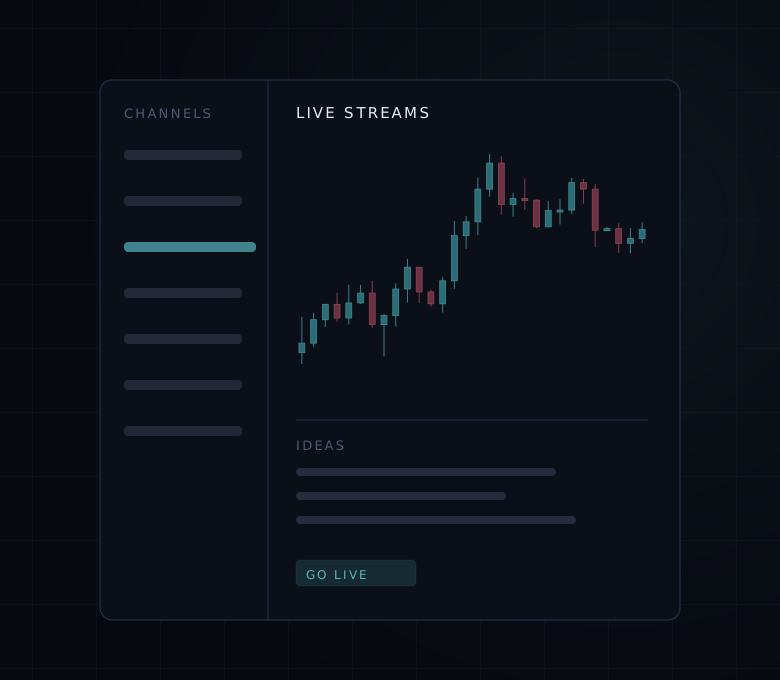
Most paid trading communities sell the same three things: ideas, education and company. The difference is what happens when an idea goes wrong. A room that only posts entries and winners is showing you a marketing feed. A room where members post the premise, the invalidation and the result, including the results that did not work, is showing you the actual work. You can tell which one you are looking at within ten minutes of reading a channel.
The criteria that separate rooms
Reasoning in the post. An idea should say why, where it is wrong, and what would change the view. "Buying dips" is not a thesis.
Named people. You should know who is talking, what their experience is, and whether they are accountable for what they publish. An anonymous admin account is not an author.
Original work. Screenshots from other people's charts, copied newsletters and reposted headlines are the cheapest content to produce and the least useful to read. Look for charts the room made itself, with the method visible.
Evidence, not adjectives. Review counts, member tenure and public track records can be checked. "70% win rate" printed on a sales page cannot.
A clear price and a clear exit. The price should be on the checkout, the renewal terms should be stated, and cancellation should be a button rather than an email chain.
Moderation. Slow channels with real discussion beat fast channels full of noise. If every message is a ticker and an emoji, the room is a chat room, not a research desk.
Red flags worth walking away from
- Guaranteed returns, "no losing months", or any performance figure that cannot be audited.
- Win-rate marketing without position sizing, drawdown or the losing trades that produced it.
- Countdown timers and "price goes up tonight" urgency. A subscription price that has to be rushed is a sales tactic, not a market signal.
- Lifetime deals priced far above a year of membership. They usually mean the seller expects churn.
- No named team, no contact route, and no terms page.
- Any room that tells you the size of your position. That is your decision, made against your account and your risk, not someone else's.
Free versus paid
Free servers are a real option, and for a beginner they are often the right first step. The trade-off is attention: a free room has no reason to keep the signal low, so volume rises and the useful posts get buried. Paid rooms invert that: the fee filters for people who intend to use the room, and the operator has an incentive to keep the content worth renewing. Neither arrangement guarantees quality; both should be judged on the work you can read before paying.
Ten questions to ask before you pay
- 01
What exactly is in the room?
Channels, streams, tools, bot commands. A list, not a promise.
- 02
Who runs it, by name?
Names, background and public work you can check independently.
- 03
Can I see an example idea?
One complete post, with the reasoning, the invalidation and the outcome.
- 04
What happens after I join?
Which channel to read first, what the session looks like, how to ask a question.
- 05
Is this advice or education?
A room that says it is education should not be telling you what to buy.
- 06
What does it cost, all in?
The price, the currency, the renewal date, and any tax added at checkout.
- 07
How do I cancel?
A self-service route in the billing platform, before the next renewal.
- 08
Who else is in there?
Review counts, member tenure, and whether the room is active on a normal Tuesday.
- 09
Do the tools need extra software?
Anything you must licence separately should be stated up front.
- 10
What is this room bad at?
A straight answer here tells you more than any testimonial.
How Traderade answers its own checklist
We publish this guide because the questions apply to us too, and a ranked list with our own name at the top would be worthless to you.
What is in the room: a daily-chart channel for ideas with reasoning, live futures streams on ES and NQ, the options positioning work, and the in-house tools (Options Viz, the Exhaustion Indicator, Dynamic Pivots) plus Gir. The full inventory is on the membership page and the server tour.
Who runs it: a small team with 40 years of combined market experience; Ayesha Tariq, CFA, appears on financial media and the team consults for institutional clients. The about page names them.
Price and exit: $69.99 a month through Whop, renewed monthly, cancelled from your Whop account. No setup fee, no annual lock-in, no urgency timer. The pricing page states the terms.
Where we are weak: the review base is small (7 reviews on Whop), there is no free trial, and the room is pitched at people who already know the basics. If you need a beginner course or a large crowd, a bigger community will serve you better. We would rather say that than take a subscription that gets cancelled in a fortnight.
Make the decision on evidence
Read the free article library. If the reasoning there is the kind of reasoning you want around your own trades, the room is the paid version of it. If not, no community fee will fix that.
What is the best swing trading Discord?
There is no universal answer: it depends on whether you need education, live analysis, tools or company. Judge each room on reasoning, named people, original work, verifiable evidence, a stated price and a self-service exit.
Are paid trading Discords worth it?
They can be, if you use them as a research desk rather than a signal feed. They are not worth it if you are paying for calls you intend to follow without checking.
Are free trading Discords better?
Free rooms are a good starting point and cost nothing to leave. The usual trade-off is noise and volume: paid rooms are smaller and filtered, but that is a filter, not a guarantee of quality.
How much should a swing trading Discord cost?
Enough that the operator has an incentive to keep the room useful, and little enough that a bad month is not a financial event. Compare the price to what you would pay for a course or a data subscription, and check the renewal terms before joining.
What should I avoid?
Guaranteed returns, unauditable win rates, countdown-timer pricing, anonymous operators, no cancellation route, and any room that sizes your positions for you.
Judge the room by the work
Read the free library, then decide whether the paid room adds anything you cannot get from a screenshot and a ticker.